Research
Publications
“Collective neutrino oscillations on a quantum computer with hybrid quantum-classical algorithm”
Abstract
We simulate the time evolution of collective neutrino oscillations in two-flavor settings on a quantum computer. We explore the generalization of the Trotter–Suzuki approximation to time-dependent Hamiltonian dynamics. The trotterization steps are further optimized using the Cartan decomposition of two-qubit unitary gates \(U \in SU(4)\) into the minimum number of controlled-NOT (CNOT) gates, making the algorithm more resilient to hardware noise. A more efficient hybrid quantum–classical algorithm is also explored to solve the problem on noisy intermediate-scale quantum (NISQ) devices.
Presentations
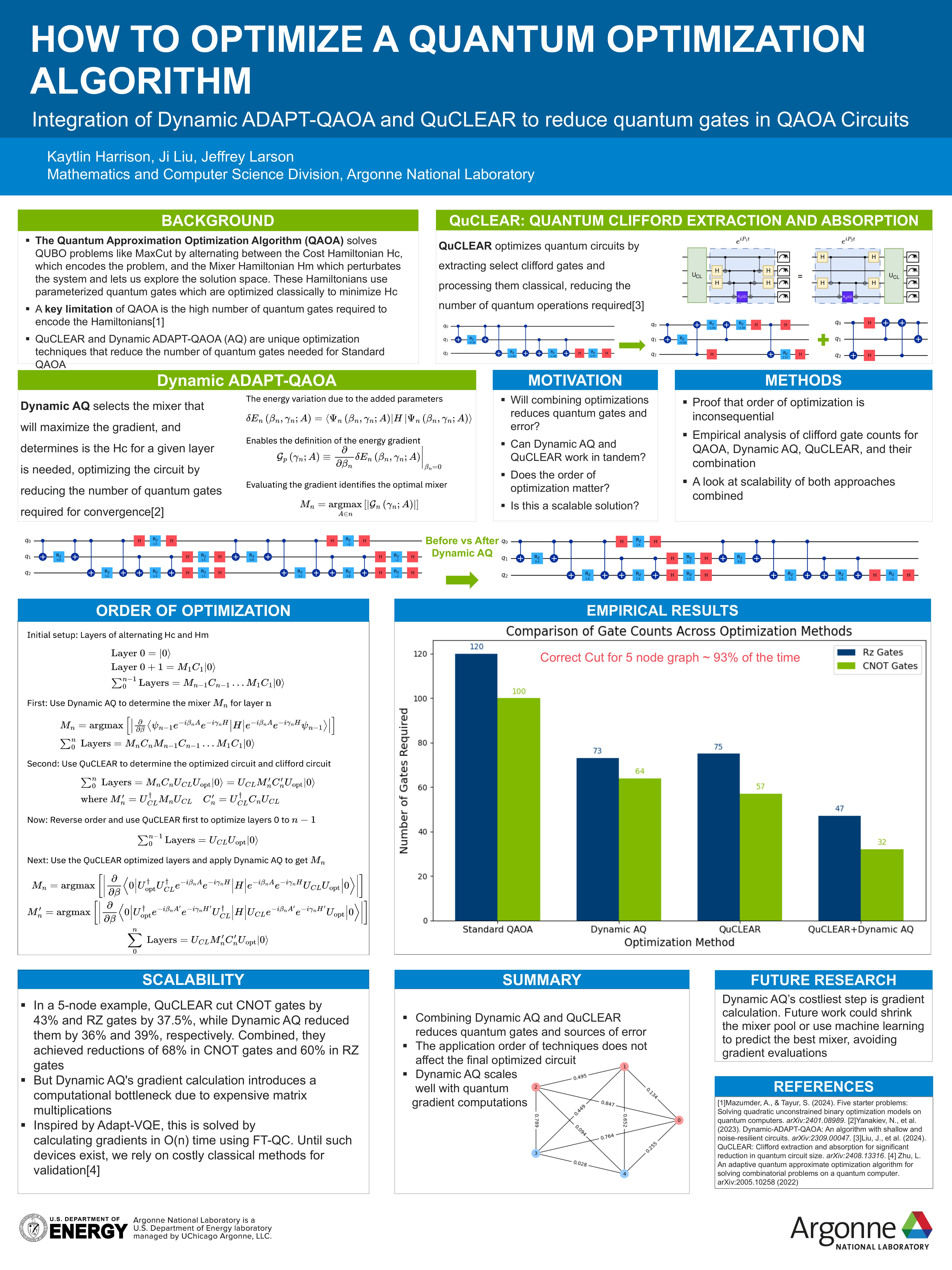
Argonne Science Poster
Quantum computing holds great promise for addressing practical challenges. However, current quantum devices suffer from noisy quantum gates, which degrade circuit fidelity. As a result, optimizing quantum circuits is essential for achieving useful results. This project explores the combination of two circuit optimization frameworks — QuCLEAR and Dynamic ADAPT-QAOA — demonstrates their individual benefits, mathematically proves that their combination yields more optimized circuits, and evaluates performance improvements on a 5-node example problem.
OQI Presentation
Focused on modeling the entanglement of neutrinos using quantum algorithms on near-term noisy quantum computers starting using both simulations on Qiskit, and pulse level quantum systems
Other Written Works
NSF GRFP — Graduate Research Plan Statement
Recipient of the NSF Graduate Research Fellowship (GRFP), 2025.